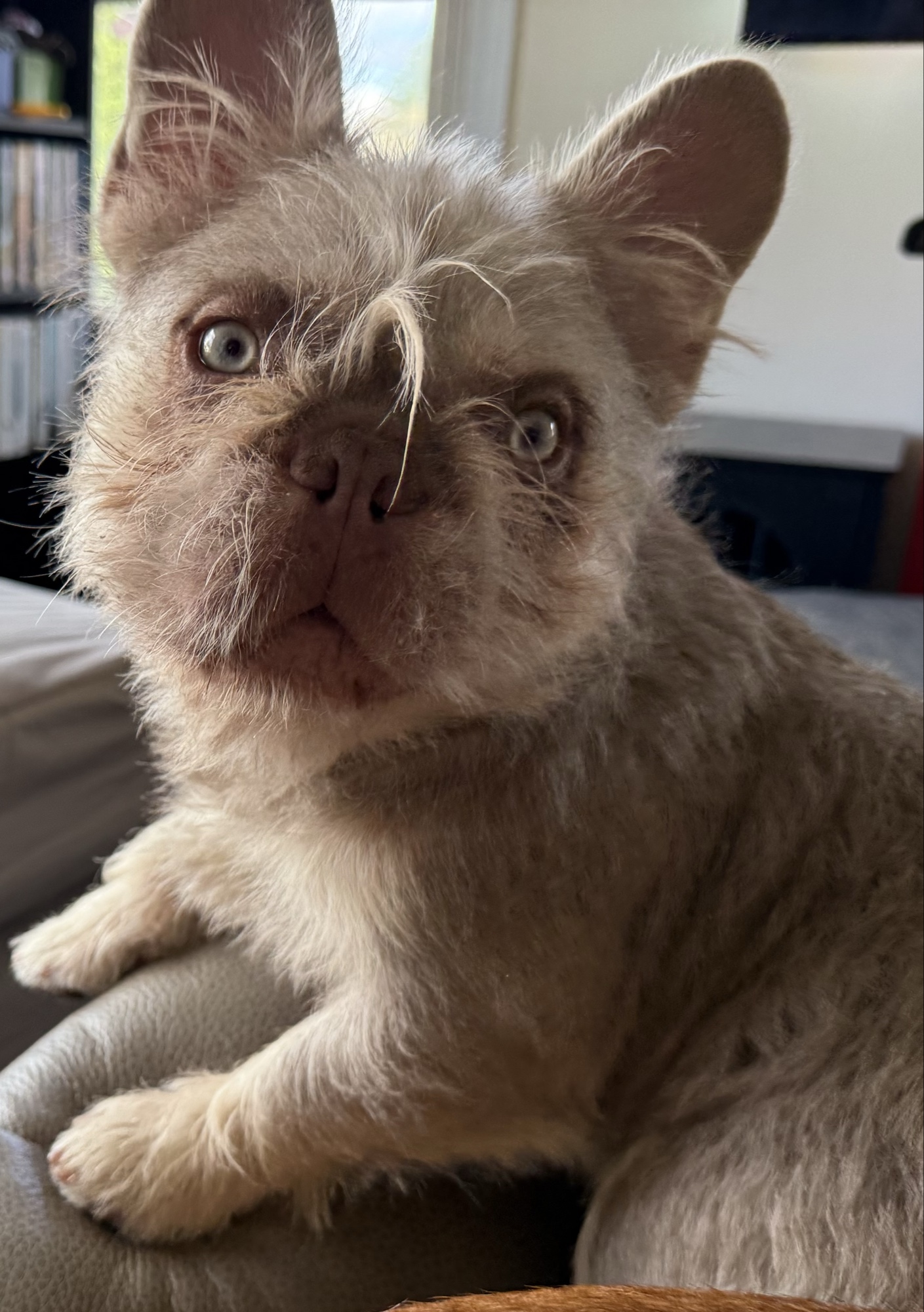
Isabel — one of my dams — is a visual fluffy. LhLh. Homozygous long-hair, common variant. She expresses it. Mouse tested as ShLh — a single fluffy carrier, expected to be short-coated. His coat is currently three times as long as hers.
When I first got Embark's short-form result, that didn't add up on paper. I said publicly I was running him through a second lab. His expanded Embark report has since resolved it, and the answer is more interesting than "the test missed something."
Embark reports his FGF5 coat-length gene across four subloci: Lh1, Lh2, Lh3, and Lh4. Mouse is ShSh at Lh1, Lh2, and Lh3 — the three common long-hair variants. He is ShLh at Lh4, the rare variant Embark documents as appearing in the Afghan Hound, Eurasier, and French Bulldog.
That is the exact French-Bulldog-specific long-hair copy I suspected. He is not carrying the common fluffy allele. He is carrying the uncommon one, which is under-represented in most Frenchie testing because it isn't the primary marker the shortened panels focus on. His coat length — longer than a typical heterozygous carrier of the common Lh1 marker — is consistent with Lh4 expression in a furnished dog.
What it doesn't do: make him a visual fluffy on his own. He is one copy, at one sublocus. He passes it to roughly half his puppies. Bred to a dam carrying any Lh variant — including Isabel — the expected result is ~25% visual fluffies in the litter, and the fluffies from that pairing are likely to be the Lh4 phenotype specifically.
This is the second-lab verification landing where I said it would. It is not what I would have written if I were trying to sell a story; it is what the report says.