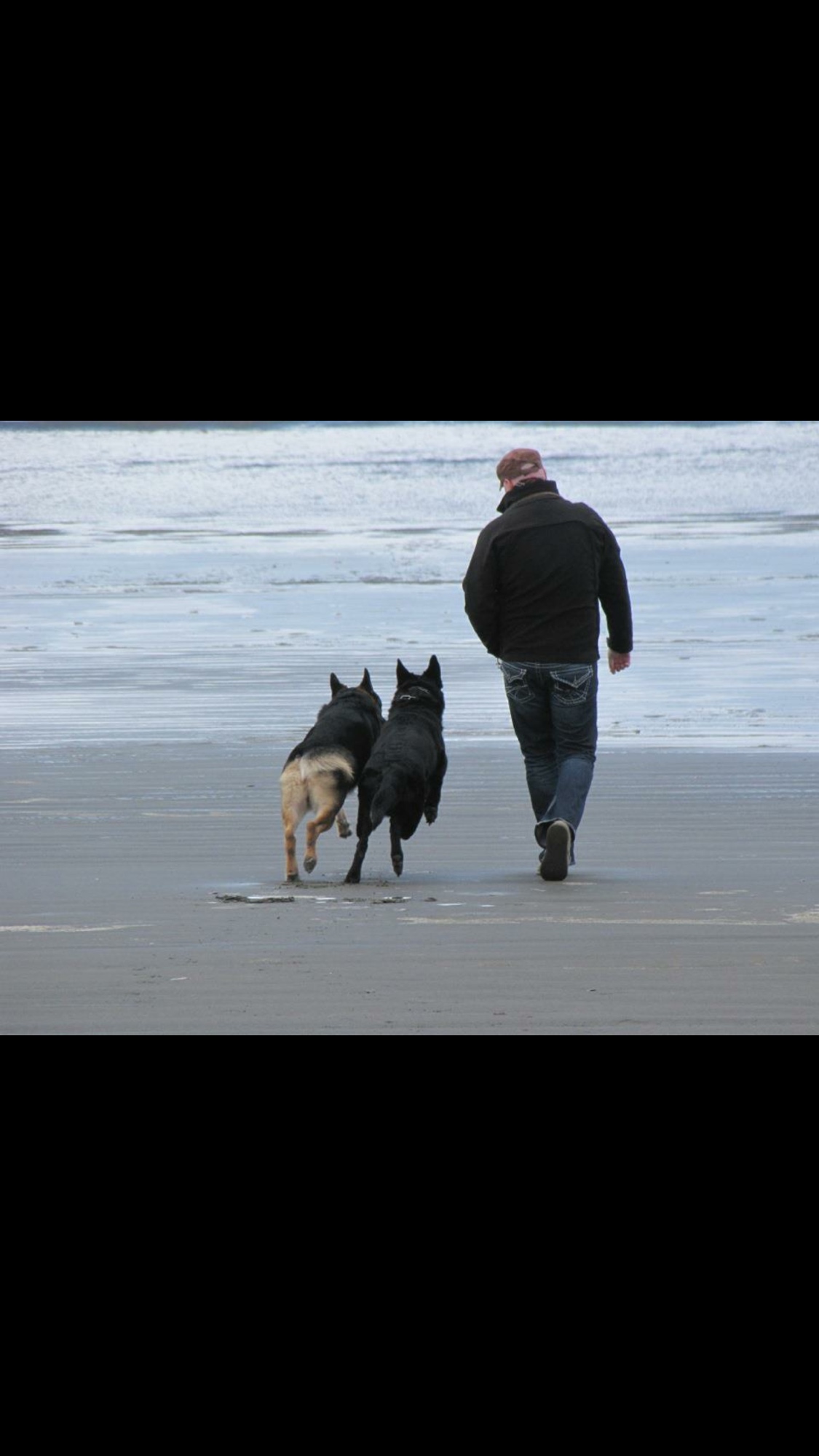
David walking two German Shepherds away down a silver beach at Ocean Shores

How Maison de Brume began

Our Story

Virginia

A different kind of dog.

The mountains of Virginia raised me around dogs — mutts and dogs bred for a purpose, working dogs that lived alongside working families. Nobody I grew up around thought of a dog as decoration. A dog had a job, or at least a role, and it earned its place at the fire by doing it well.

That's the part of my childhood I never lost. I have always been more interested in what a dog is than in what a dog looks like. Temperament first. Then structure, because structure is what lets a temperament last for fifteen years instead of five.

A German Shepherd standing in forest light among ferns
Forest light. The dogs that taught me what structure is worth.

The working years

Dobermans and German Shepherds.

For most of my adult life I lived with the serious end of the dog world: Dobermans and German Shepherds, trained for personal protection. That work rewires how you look at animals. You stop admiring a dog's head and start watching its rear angulation on a turn. You learn to hear a dog breathing across a room. You learn that a dog with a beautiful outline and a nervous mind is a liability, and a dog with a plain outline and a stable mind is a treasure.

I did nonprofit work in those years and traveled a good part of the world doing it. Dogs came with me where they could, and where they couldn't, they were waiting at home. Protection training taught me the discipline of selection — that you commit to the dog in front of you, and that the honest work happens long before the puppy is born.

The switch

Life took a new shape.

Then I got sick. It was sudden, and it was brief, and it ended in an organ transplant.

Life has a different shape after something like that. Mine got quieter and, in some ways, clearer. What it did not get was stronger. My body simply cannot take the punishment of building and maintaining a hundred-pound working dog anymore — the bitework, the decoy sessions, the daily physical negotiation with an animal that outweighs your recovery.

I was not willing to stop living with dogs. So I had to find a dog that could carry the same spirit at a scale my body could actually handle.

Black German Shepherd silhouetted in dune grass with the ocean behind
The pivot. Same ocean, different life.

Why Frenchies

Big dog personality, little dog body.

The French Bulldog is the only breed I found that kept everything I loved about working dogs and dropped the part I could no longer carry. They are bold. They are funny. They are stubborn in a way that means there is an actual mind in there arguing with you. They read a room and they read a person.

What they don't do is drag you down a driveway. A well-built Frenchie is a compact, confident, opinionated animal in a twenty-five pound frame — big dog personality, little dog body. That's the whole thesis. I wanted to keep the working-dog spirit at a scale my body could handle, and this is the breed that made it possible.

Eighteen months

The research came before the puppy.

I spent eighteen months studying this breed before I bought my first puppy. Not browsing — studying. Frenchie against Frenchton, side by side, on health outcomes and structure and temperament. Color genetics, locus by locus, until I could read a panel without a cheat sheet. Spinal conformation. Airway conformation. Life expectancy data. What actually kills these dogs and at what age.

I read the standards of different countries against each other — FCI, AKC, and the UK Kennel Club — because the differences between them tell you what each culture decided to prioritize, and what each one let slide. I talked to breeders who had been in the breed for decades, including ones who disagreed with each other loudly. I sat down with a veterinarian and went through the failure modes one at a time.

And I flew to France, because I wanted to see the breed at home. I met European breeders. I walked the villages where the type was preserved. I wanted to understand the FCI standard from inside the country that wrote it, rather than from a document translated and reinterpreted an ocean away. That trip was research, not a vacation — it changed what I look for in a dog.
The trips

Arkansas. Ohio. Pennsylvania. Tennessee.

Photos lie. Video lies less, but it still lies. The only way to know a dog is to put your hands on it — to feel the spine, watch it move away from you, listen to it breathe after it plays.

So I flew to Arkansas, Ohio, Pennsylvania, and Tennessee. I drove up and down the west coast meeting breeders and dogs, sometimes for one hour with one animal before turning around. Most of those trips ended in a no. That is the point of the trip. Every dog in this house is here because I saw it in person first, and every dog I didn't bring home taught me something about what I was actually looking for.

From FogBank to Maison de Brume

The name grew up with the program.

This program started publicly as FogBank Frenchtons — the name that carried it through the first litters, the first health protocols, the road trips and the research. It's still where you'll find us on TikTok and Instagram (@fogbankfrenchtons on both), where our day-to-day life with the pack lives.

Maison de Brume Bulldogs LLC is the same program, formally incorporated. The name — French for House of Mist — is my nod to the Puget Sound fog that raises these dogs, and to the country that gave us the breed. Same pack. Same standards. Same person answering every email. Just a name that carries the weight of what we're trying to build.

Meet Oyuki

The Doberman is still here.

His name is Oyuki. He came out of the working years and he never left.

He is the pack leader and the uncle of this operation, and those two jobs are the same job. He sets the tone in the house — puppies learn manners from him faster than they learn them from me, because a correction from an adult dog is instant, proportionate, and never personal. He supervises the whelping box. He breaks up nonsense before it escalates. He tolerates an astonishing amount of ear-chewing from animals a tenth his size.

Every puppy raised here grows up around a stable, confident adult dog of a completely different size and shape. That's not an accident of who I happen to own. It's part of the program.

Oyuki, an intact male melanistic white Doberman with cropped ears, in a formal seated portrait
Oyuki. Pack leader, uncle, and the reason the puppies have manners.

Where it stands

The second half.

Most mornings end up on the water. Oyuki takes the wet sand at the edge of the tide, the Frenchies negotiate with the kelp, and the fog does what fog does here — it makes everything about forty feet wide and very quiet. This is the life I got back, and this is the life the dogs are part of.

I am a painter by training and I still paint. Breeding is the same discipline pointed at something living: study the material, respect what it wants to do, and don't lie about the result. That's the whole practice.

David walking with Oyuki on wet sand at golden hour
Golden hour, low tide, the dog who stayed.

An organ donor gave me the second half of my life. If you'd like to give someone theirs — register at registerme.org.

See our current puppies Read our philosophy